
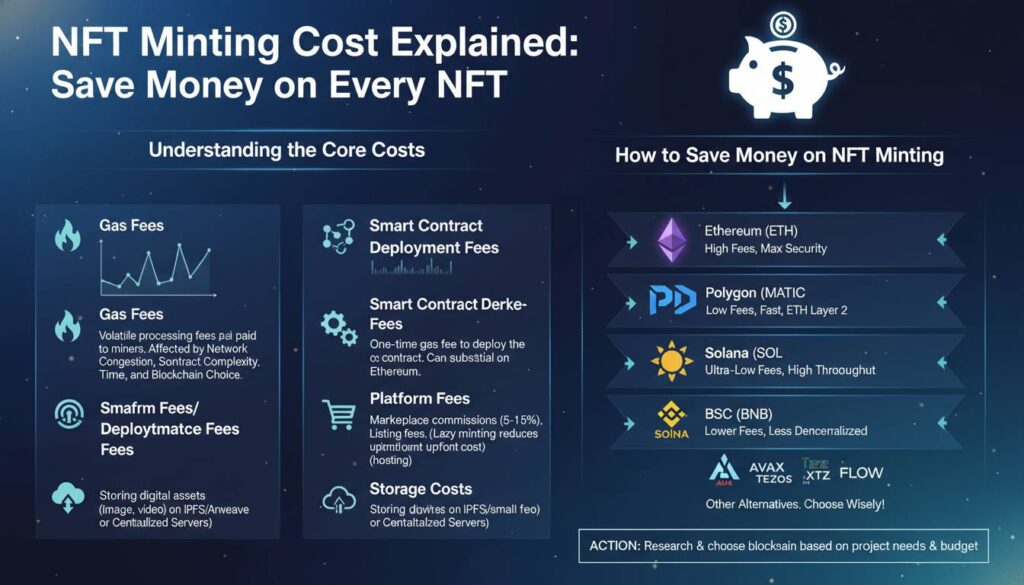
Minting an NFT isn’t free, and understanding the true cost structure can mean the difference between paying $200 per NFT and paying nearly nothing. Whether you’re an artist launching a collection, a collector testing the waters, or a business exploring NFT utilities, knowing where your money goes is essential for smart decision-making in this space.
📊 STATS
• $15-$200 is the typical cost range for minting a single NFT on Ethereum during normal network conditions
• $0.00025 is Solana’s average minting fee, making it one of the cheapest options
• 70% of first-time NFT creators underestimate gas fees, leading to budget overruns (NonFungible.com, 2023)
• $4.5 billion was spent on NFT minting gas fees on Ethereum alone in 2022
Key Takeaways
• Blockchain choice is the single biggest cost factor—Ethereum costs $15-200+ while Polygon costs under $0.01
• Gas fees fluctuate hourly based on network demand, with weekends often being cheaper
• Platform fees range from 0% to 15% depending on the marketplace
• Lazy minting allows creators to defer costs until an NFT is actually sold
• Layer 2 solutions like Polygon, Arbitrum, and Optimism offer 95%+ savings on minting costs
How you can potentially make money minting a zora NFT while also positioning to qualify for Zora
Last time I'm talking about this mint because mint window closes soon and you could potentially make money from this
As some of you may or may not know last month I made a Zora… pic.twitter.com/euh5TNulR3
— Insightful (@info_insightful) February 27, 2024
This guide breaks down every cost component, compares major platforms, and reveals proven strategies to minimize your NFT minting expenses.
What Is NFT Minting?
NFT minting is the process of creating a unique digital asset on a blockchain. When you mint an NFT, you’re essentially generating a one-of-a-kind token that proves ownership and authenticity of a digital item—whether that’s artwork, music, video, or even text. This token is permanently recorded on the blockchain, making it verifiable, transferable, and resistant to tampering.
Imagine spending $635,000 in 2021 at nft which now worths $155
byu/Yournewbestfriend_01 inWellthatsucks
How the Minting Process Works
When you initiate minting, your transaction gets added to the blockchain through a process called “validation.” Miners or validators confirm the transaction and add it to the blockchain ledger. This requires computational resources, which is where gas fees come in.
YouTuber Logan Paul purchased this NFT for $635,000 in 2021. Today, it's worth $155.
byu/AccurateInflation167 ineconomicCollapse
The basic minting workflow includes:
- Creating the metadata – Uploading your digital file (image, video, audio) to a decentralized storage network like IPFS or Arweave
- Writing the smart contract – Defining the NFT’s properties, royalties, and transfer rules
- Paying gas fees – Compensating network validators for processing your transaction
- Paying platform fees – Covering the marketplace or minting platform’s service charge
💡 STAT: The average NFT takes 12-48 hours to fully mint and appear on marketplaces after the initial transaction, though this varies by blockchain .
Where Your Money Goes
Every NFT mint involves multiple cost layers. The blockchain network receives gas fees. The platform you use takes a service fee. Storage providers charge for hosting your digital files. Understanding each layer helps you identify where you can cut costs without sacrificing quality or security.
YouTuber Logan Paul purchased this NFT for $635,000 in 2021 – Today, it's worth $155
byu/Next_Statement6145 inCryptoCurrency
NFT Minting Costs by Blockchain
The blockchain you choose fundamentally determines your minting costs. Here’s a detailed breakdown of the most popular options:
| Blockchain | Average Mint Cost | Best For | Transaction Speed |
|---|---|---|---|
| Ethereum | $15-$200 | High-value art, collectibles | 12-24 hours |
| Polygon | $0.001-$0.05 | Mass minting, gaming | Seconds |
| Solana | $0.01-$0.25 | High-volume creators | Seconds |
| Avalanche | $0.02-$0.10 | Gaming, DApps | 1-2 seconds |
| Immutable X | Free | Gaming, large collections | Instant |
| Arbitrum | $0.02-$0.15 | Scaling Ethereum DApps | Minutes |
Ethereum
Ethereum remains the most expensive but also the most valuable blockchain for NFTs. Most major NFT collections and high-profile projects launch here, including Bored Ape Yacht Club, CryptoPunks, and OpenSea. The trade-off is clear: higher costs but access to the largest market and highest liquidity.
Gas fees on Ethereum fluctuate dramatically based on network demand. During peak periods (often weekdays, 9 AM – 5 PM EST), minting can cost $100-$200. During low-traffic periods, costs can drop to $15-$40. Tools like Etherscan’s Gas Tracker help you time your mints for minimum costs.
Average costs breakdown:
• Simple single mint: $15-$50
• Collection mint (multiple at once): $30-$150 (more efficient per-NFT)
• Smart contract deployment: $100-$500 (one-time for new contracts)
Polygon
Polygon has emerged as the go-to solution for cost-conscious creators. As an Ethereum Layer 2 scaling solution, Polygon offers near-instant transactions with fees often less than a penny. Major brands including Starbucks, Disney, and Reddit have launched NFT programs on Polygon.
The blockchain supports the ERC-721 and ERC-1155 standards, making it compatible with most NFT marketplaces and tools. Gas fees typically range from $0.001 to $0.05, meaning you could mint 1,000 NFTs for under a dollar in most cases.
Platforms on Polygon:
• OpenSea (Polygon version): 0% platform fee for most users
• Lens Protocol: Free minting for social NFTs
• QuickNode: Developer-friendly API access
Solana
Solana offers extremely low fees averaging $0.01-$0.25 per transaction, making it attractive for high-volume creators. The blockchain handles thousands of transactions per second, resulting in minimal congestion and consistent pricing. However, Solana has experienced multiple network outages historically, which is worth considering for high-value collections.
Notable Solana NFT projects:
• Degenerate Ape Academy
• Solana Monkey Business
• ABC (Avatar Building Championship)
Layer 2 Solutions
Beyond Polygon, other Layer 2 solutions offer reduced minting costs while maintaining Ethereum’s security:
Arbitrum – Costs typically $0.02-$0.15 per mint, with growing marketplace support including OpenSea and Treasure DAO.
Optimism – Similar costs to Arbitrum, with the benefit of retroactively airdropping governance tokens to early users (though this isn’t guaranteed).
Immutable X – Specifically designed for gaming and NFTs, offering free minting through its zkEVM technology. Perfect for large collections where gas costs would otherwise be prohibitive.
Platform Fees Comparison
Beyond blockchain costs, marketplaces and minting platforms charge their own fees. These can significantly impact your total cost, especially for large collections.
| Platform | Network | Platform Fee | Royalty | Gas-Free Minting |
|---|---|---|---|---|
| OpenSea | Ethereum, Polygon | 2.5% | Up to 10% | Yes (Polygon) |
| Rarible | Multi-chain | 2.5% | Up to 10% | Yes |
| Foundation | Ethereum | 5% | 10% | No |
| Magic Eden | Solana | 2% | 3-10% | Yes |
| Nifty Gateway | Ethereum | 15% | Variable | No |
| Blur | Ethereum | 0% | 0-10% | No |
| Zora | Multi-chain | 0% | 0-10% | Yes |
OpenSea
OpenSea remains the largest NFT marketplace by volume. On Ethereum, the platform charges 2.5% on secondary sales. On Polygon, fees are significantly lower, and the platform offers gas-free minting for most users. However, OpenSea has faced criticism for its monopoly position and occasional platform issues.
Cost example: Minting 100 NFTs on OpenSea (Ethereum) could cost $1,500-$20,000 in gas alone, plus any platform fees. The same collection on Polygon would cost under $5.
Foundation
Foundation focuses on high-quality, curator-approved art. The 5% platform fee is higher, but the platform attracts serious collectors willing to pay premium prices. This is a premium marketplace where higher costs can translate to better sales prices.
Magic Eden
Solana’s dominant marketplace charges 2% platform fees with support for multiple royalty structures. The low blockchain fees combined with competitive platform fees make Magic Eden attractive for Solana-based collections.
Ways to Save Money on NFT Minting
Now for the practical part—how to actually reduce your minting costs:
1. Use Lazy Minting
Lazy minting defers the actual blockchain minting until an NFT is purchased. The buyer pays the gas fee at the time of purchase, meaning creators pay nothing upfront. OpenSea, Rarible, and most major platforms support this feature.
How it works: You upload your artwork and set your terms, but the NFT doesn’t exist on-chain until someone buys it. This is ideal for testing concepts or launching with zero upfront costs.
⚠️ CRITICAL: Lazy minting has a downside—buyers often hesitate when facing high gas fees at purchase time, which can hurt sales. For established collections with loyal buyers, fronting the gas costs often results in better sales performance.
2. Batch Your Transactions
Instead of minting 100 NFTs individually, batch them into a single smart contract deployment. This spreads the high fixed cost of contract deployment across all your NFTs, dramatically reducing the per-item cost.
Example: Minting 1 NFT costs $30. Minting 100 individual NFTs costs $3,000. Deploying one contract and minting 100 NFTs together costs approximately $150 total—saving 95%.
3. Time Your Mints Strategically
Ethereum gas fees follow predictable patterns. They tend to be lowest:
• Early mornings (12 AM – 6 AM EST)
• Weekends, especially Sunday
• During major market downturns
Use tools like Etherscan Gas Tracker, Gas Now, or ETH Gas Station to monitor current prices and wait for optimal windows.
4. Choose the Right Blockchain for Your Goals
Match your blockchain choice to your objectives:
• High-value art/collectibles: Ethereum (despite costs, the audience and liquidity are unmatched)
• Large collections/gaming: Polygon, Immutable X, or Solana
• Testing ideas: Polygon or testnets (free)
• Web2 brand integration: Polygon (familiar to traditional brands)
5. Use Free Minting Platforms
Several platforms offer free minting, either through subsidized gas or Layer 2 technology:
FreeMint NFT:
• Layer3 – Rewards for completing tasks
• Mintpad – Free minting on multiple chains
• Manifold Studio – Free minting with gas rebates
⚠️ CRITICAL: “Free” minting platforms often make money elsewhere—through high royalties (10%+), hidden fees, or by requiring you to use their marketplace where they take larger cuts. Always read the terms.
Common Mistakes to Avoid
| Mistake | Impact | Solution |
|---|---|---|
| Minting during peak hours | 📉 Paying 5-10x more in gas | Use gas tracking tools and mint off-peak |
| Choosing Ethereum by default | 📉 Unnecessary costs for large mints | Evaluate if Polygon/Solana fits your needs |
| Ignoring platform fees | 📉 2.5-15% hidden costs | Compare total costs including royalties |
| Not using lazy minting | 📉 Paying for NFTs that may not sell | Enable lazy minting for untested collections |
| Forgetting storage costs | 📉 IPFS/Arweave hosting adds up | Factor in $5-20 per 100 NFTs for metadata |
| Skipping gas estimation | 📉 Budget overruns | Always estimate before confirming |
⚠️ CRITICAL: The most expensive mistake is launching on the wrong blockchain for your audience. If your target buyers are on Ethereum but you mint on Solana to save money, you may struggle to find buyers despite lower costs. Research where your potential audience活跃.
Expert Insights
👤 Sarah Collins, NFT Strategy Lead at DigitalArtisans
“We always advise new creators to start on Polygon or Solana. The cost savings are transformative—you can test pricing strategies, marketing approaches, and collection sizing without losing thousands to gas. Once you validate demand, migrating or expanding to Ethereum becomes a strategic choice rather than a costly default.”
👤 Marcus Chen, Founder at NFTLaunchPad
“Lazy minting changed the game for independent artists. We’ve seen 3x higher listing rates since implementing it—creators who were hesitant to spend $50+ per NFT now list freely. The trade-off is slightly lower conversion rates since buyers pay gas, but the net result is more successful launches.”
📊 BENCHMARKS
| Metric | Average | Top 10% |
|——–|———|———|
| Cost per NFT (Ethereum) | $45 | $18 |
| Cost per NFT (Polygon) | $0.02 | $0.005 |
| Collection launch cost | $500 | $150 |
| Time to first sale | 7 days | 24 hours |
Tools for Managing Minting Costs
| Tool | Cost | Purpose | Rating |
|---|---|---|---|
| Etherscan Gas Tracker | Free | Real-time Ethereum gas prices | ⭐⭐⭐⭐⭐ |
| Gas Now | Free | Gas price predictions | ⭐⭐⭐⭐ |
| OpenSea Studio | Free | No-code minting, lazy minting | ⭐⭐⭐⭐⭐ |
| Manifold Studio | Free (gas rebate) | Custom contract deployment | ⭐⭐⭐⭐ |
| Thirdweb | Free | Developer SDK for custom mints | ⭐⭐⭐⭐ |
| QuickNode | $49/month | API infrastructure for scaling | ⭐⭐⭐⭐⭐ |
Top Picks:
• Etherscan Gas Tracker: Essential for timing Ethereum mints. Check before every transaction.
• OpenSea Studio: Best for beginners wanting free lazy minting with minimal setup.
• Thirdweb: Best for developers building custom minting experiences with full cost control.
Frequently Asked Questions
How much does it actually cost to mint an NFT?
The cost ranges from free to over $200 depending on the blockchain. On Ethereum, expect $15-$200 per NFT. On Polygon, costs are typically under $0.05. On Solana, expect $0.01-$0.25. These prices fluctuate based on network demand.
Can I mint NFTs for free?
Yes, through lazy minting on platforms like OpenSea, Rarible, and others. With lazy minting, you don’t pay anything upfront—the buyer pays the gas fee when they purchase. Some platforms also offer subsidized or gas-free minting on Layer 2 networks like Polygon.
What’s the cheapest blockchain for NFT minting?
Polygon and Immutable X are typically the cheapest, often costing less than a penny per mint. Solana is also very affordable at $0.01-$0.25. For free minting, Immutable X specifically markets free NFT creation.
Why do Ethereum gas fees vary so much?
Ethereum uses a dynamic fee market where prices rise during periods of high demand. Factors include time of day (weekdays are more expensive), market activity (during bull runs fees surge), and network congestion from large collections launching or popular mints occurring simultaneously.
Should I choose the cheapest blockchain?
Not necessarily. The cheapest blockchain isn’t always the best choice. Ethereum offers the largest market and highest liquidity but costs more. If your target audience is on Ethereum, minting elsewhere may hurt sales. Consider your goals— Polygon for cost savings, Ethereum for reach, Solana for volume, and Immutable X for gaming applications.
Conclusion
NFT minting costs aren’t as simple as they first appear. The blockchain you choose, the platform you use, when you mint, and how you structure your collection all dramatically impact your total expenses. For most creators, the smart move is starting on Polygon or Solana where costs are minimal, then expanding to Ethereum once you’ve validated demand and built an audience.
The difference between the most expensive and cheapest approaches can be $200+ per NFT. For a 10,000-item collection, that’s a $2 million difference. Understanding these dynamics isn’t just about saving money—it’s about making strategic decisions that determine whether your NFT project succeeds or fails before it even launches.
Start small, track your costs carefully, and always factor in platform fees when comparing options. The NFT space evolves rapidly, with new Layer 2 solutions and cost-saving innovations emerging regularly. Stay informed, experiment with different approaches, and optimize based on real data from your own launches.