
The cryptocurrency world is buzzing with anticipation as Bitcoin approaches its fourth halving event in April 2024. This quadrennial occurrence, hardcoded into Bitcoin’s protocol since its inception, reduces the reward miners receive for validating blocks by half—directly impacting the asset’s supply dynamics. Market analysts, institutional investors, and retail traders are closely monitoring developments, with many speculating whether Bitcoin could finally breach the coveted $100,000 mark this cycle. As historical patterns and emerging market forces collide, the question remains: will 2024 deliver the historic bull run that halving enthusiasts predict?
Understanding Bitcoin Halving: The Basics
Bitcoin halving represents one of the most distinctive features of the cryptocurrency’s monetary policy. Built into the protocol by its anonymous creator Satoshi Nakamoto, the event occurs every 210,000 blocks—approximately every four years—cutting the block reward miners receive in half. This mechanism ensures that Bitcoin’s total supply remains capped at 21 million coins, creating a deflationary model that mimics precious metals like gold.
The upcoming halving will reduce the block reward from 6.25 BTC to 3.125 BTC, marking the fourth such reduction since Bitcoin’s launch in 2009. At that time, miners received 50 BTC per block. The first halving in 2012 reduced this to 25 BTC, followed by 12.5 BTC in 2016, and 6.25 BTC in 2020. Each reduction directly impacts miner revenue, prompting intense debate about network security and the economic implications for participants throughout the ecosystem.
The fundamental thesis behind Bitcoin halving predictions stems from basic supply and demand economics. With new Bitcoin creation slowing by 50%, analysts argue that reduced supply growth combined with steady or increasing demand should drive prices higher. However, numerous other factors—including regulatory developments, macroeconomic conditions, and institutional adoption—complicate the equation significantly.
Historical Performance: Lessons From Previous Halvings
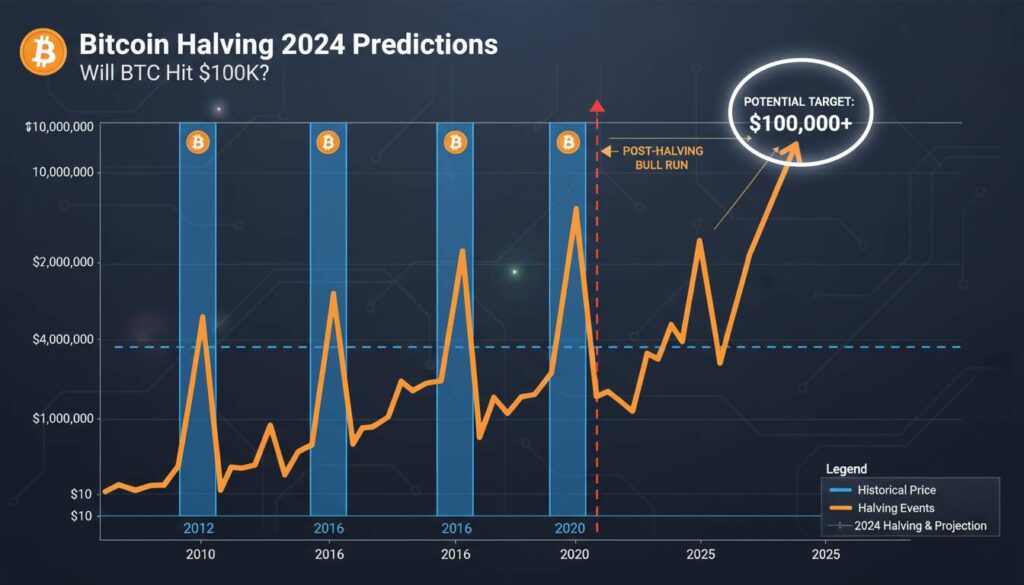
Examining past halving events reveals compelling patterns that fuel optimism among Bitcoin proponents. The 2012 halving saw Bitcoin rise from approximately $12 to over $1,100 within a year—a staggering return that established the template for subsequent cycles. The 2016 halving preceded a run from around $650 to nearly $20,000 by December 2017, while the 2020 halving preceded the 2021 bull run that pushed Bitcoin to its all-time high of $69,000.
Each cycle has demonstrated progressively higher price floors, with each subsequent halving marking a higher starting point for the next rally. Critics note, however, that past performance does not guarantee future results, and that external market conditions have varied considerably across cycles. The 2020 halving occurred during unprecedented global monetary stimulus, while the 2024 environment presents different macroeconomic challenges including persistent inflation and geopolitical tensions.
The concept of “halving cycles” has become deeply embedded in cryptocurrency market analysis. Technical analysts point to the roughly 18-month timeline following each halving as the period when price appreciation typically materializes most dramatically. This pattern suggests that if history repeats, Bitcoin could experience its most significant gains during late 2024 and into 2025.
Market Analysis: Current Sentiment and Data
As of early 2024, Bitcoin trades well above its previous cycle highs, with the cryptocurrency maintaining support above $40,000 throughout late 2023. This performance has exceeded many analyst expectations and suggests strengthened institutional interest following the approval of Bitcoin exchange-traded funds in January 2024. The ETF approvals have fundamentally altered the landscape for Bitcoin investment, providing traditional financial institutions with regulated vehicles for exposure.
Trading volumes and on-chain metrics indicate sustained interest from both retail and institutional participants. Bitcoin’s market capitalization has consistently ranked it among the world’s most valuable assets, while derivatives markets show elevated open interest in futures and options contracts. This suggests that professional traders are positioning for significant volatility surrounding the halving event.
Exchange reserves have declined substantially over the past year, indicating that long-term holders are accumulating rather than distributing their holdings. The Bitcoin supply on exchanges has reached multi-year lows, a pattern that historically precedes price appreciation when demand increases. Miner revenue, while still robust, faces compression from the impending reward reduction, prompting discussions about potential network hashrate adjustments and mining economics.
Expert Perspectives: What Industry Leaders Are Saying
Industry analysts have offered varied predictions for the 2024 halving cycle, with estimates ranging from conservative projections of $80,000 to more aggressive targets exceeding $150,000. Investment firms have increasingly incorporated Bitcoin into their strategic outlooks, with several major banks acknowledging its potential role in diversified portfolios.
Market analysts generally agree that the macroeconomic environment will play a crucial role in determining outcomes. Federal Reserve policy decisions, inflation trajectories, and global economic stability will influence capital flows into risk assets including cryptocurrencies. The relationship between Bitcoin and traditional markets has strengthened in recent years, suggesting that broader financial conditions will impact its performance.
The conversation around Bitcoin’s store of value proposition has matured considerably. Once dismissed as purely speculative, Bitcoin now occupies a recognized position in many investment strategies as a hedge against monetary inflation and currency devaluation. This institutional acceptance has transformed the narrative around halving events, with professional investors approaching the 2024 cycle with systematic frameworks rather than pure speculation.
Technical analysts point to chart patterns and cycle theory as justification for bullish outlooks. The logarithmic growth curves that have characterized Bitcoin’s historical trajectory suggest that each cycle reaches a higher high than the previous one, though the magnitude of gains has diminished with increased market capitalization. Whether this pattern continues remains one of the central questions facing market participants.
Impact on Miners and the Network
The halving event carries profound implications for Bitcoin miners, whose profitability depends directly on block rewards and transaction fees. Historical data shows that mining difficulty adjusts approximately every two weeks, ensuring that blocks continue to be produced at consistent intervals regardless of total network hashrate. This adjustment mechanism protects the protocol’s integrity but creates competitive pressure for miners.
Smaller mining operations face particular challenges during halving events, as reduced block rewards compress margins while operational costs remain constant. This dynamic has historically triggered consolidation in the mining industry, with less efficient operations being acquired or forced out of the market. Larger, more efficient mining companies have generally weathered previous halvings, though each cycle tests their operational resilience.
Network security concerns occasionally emerge around halving periods, with critics questioning whether reduced block rewards maintain sufficient incentive for miners to secure the blockchain. Evidence from previous halvings suggests these concerns prove unfounded, as transaction fees typically increase during periods of high network activity, partially compensating for reduced block rewards. The interplay between block rewards and transaction fees continues to evolve as Bitcoin’s usage patterns develop.
Regulatory Landscape and Institutional Adoption
The regulatory environment surrounding Bitcoin has grown considerably more sophisticated since the previous halving cycle. Clearer regulatory frameworks in major markets including the United States have provided institutional investors with greater confidence in cryptocurrency allocations. The Securities and Exchange Commission’s approval of spot Bitcoin ETFs marked a watershed moment, potentially opening Bitcoin exposure to millions of retirement accounts and managed portfolios.
Regulatory clarity varies significantly across jurisdictions, creating a complex global landscape for Bitcoin adoption. Some nations have embraced cryptocurrency innovation, while others have implemented restrictive measures that limit participation. The tension between regulatory oversight and technological innovation remains a defining feature of the cryptocurrency discourse.
Central bank digital currencies represent another regulatory consideration that could influence Bitcoin’s trajectory. As governments worldwide explore digital versions of their currencies, Bitcoin’s decentralized, non-governmental nature becomes increasingly distinctive. Proponents argue that this differentiation strengthens Bitcoin’s value proposition as an alternative monetary system.
Conclusion: Navigating the 2024 Bitcoin Halving
The Bitcoin halving in 2024 represents a pivotal moment in cryptocurrency history, offering an opportunity to observe how market dynamics evolve as the asset class matures. While historical patterns suggest potential for significant price appreciation, numerous factors including macroeconomic conditions, regulatory developments, and shifting market sentiment will ultimately determine outcomes.
Investors considering positions in Bitcoin should approach the halving event with clear understanding of the risks involved. The cryptocurrency remains highly volatile, and predictions—even those from experienced analysts—carry substantial uncertainty. Diversification, thorough research, and position sizing appropriate to individual risk tolerance remain prudent strategies regardless of market conditions.
As April 2024 approaches, the cryptocurrency community watches with keen interest. Whether Bitcoin achieves new record highs or experiences a more measured trajectory, the halving event underscores the unique monetary policy embedded in Bitcoin’s protocol. The intersection of technological innovation, market speculation, and macroeconomic forces will determine the narrative of this cycle, as it has for each halving that preceded it.
Frequently Asked Questions
When exactly will the Bitcoin halving occur in 2024?
The Bitcoin halving is expected to occur in April 2024, though the exact date depends on block production timing. The event happens automatically when the blockchain reaches block height 840,000, with the estimated timing based on current hashrate and block intervals.
How much will the block reward decrease?
The block reward will decrease from 6.25 BTC to 3.125 BTC per block, representing a 50% reduction in new Bitcoin creation. This change affects miner revenue directly and is the primary driver behind supply-side predictions.
Will Bitcoin definitely reach $100,000 in 2024?
No outcome is guaranteed, and Bitcoin price predictions involve substantial uncertainty. While many analysts project prices above $100,000 based on historical patterns and current market dynamics, the cryptocurrency remains volatile and subject to numerous external factors including regulatory changes and macroeconomic conditions.
How does the halving affect Bitcoin miners?
The halving reduces miner revenue by 50% from block rewards, creating pressure on operational margins. Some miners may exit the network if they cannot operate profitably, while others may benefit from increased transaction fees during periods of high demand.
Should I buy Bitcoin before or after the halving?
Investment timing decisions are highly individual and depend on personal financial situations and risk tolerance. Past performance does not guarantee future results, and purchasing before or after the halving carries both potential advantages and risks.
How does the 2024 halving differ from previous events?
The 2024 halving occurs with significantly more institutional participation than previous cycles, particularly following the approval of spot Bitcoin ETFs in early 2024. This mainstream acceptance represents a fundamental change in how investors can access Bitcoin exposure.