
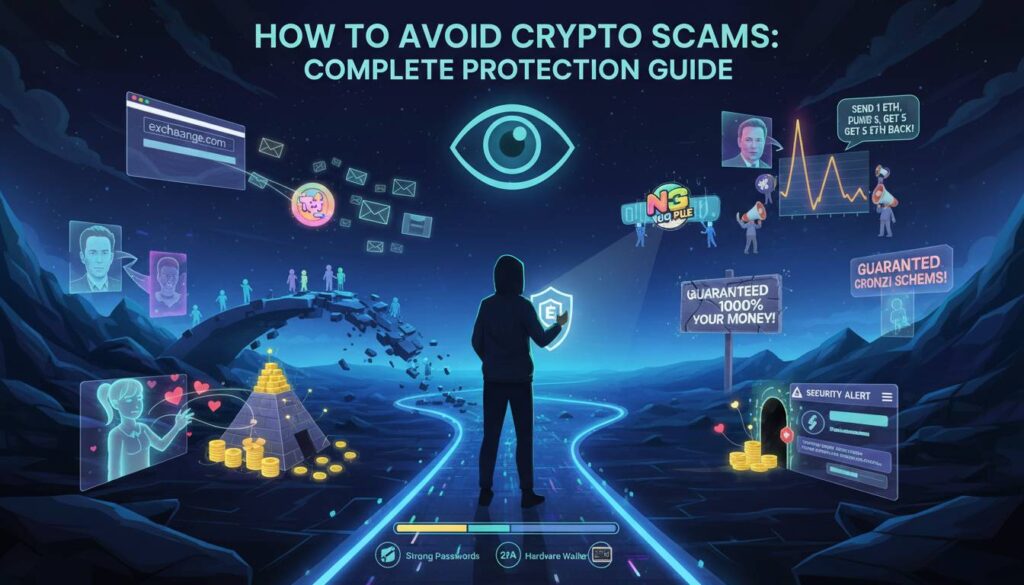
The cryptocurrency landscape has transformed finance, but it has also created fertile ground for scammers. In 2023 alone, crypto investors lost approximately $1.7 billion to fraud, according to the FBI’s Internet Crime Report. That’s $1.7 billion gone—not to market crashes or bad investments, but to deliberate theft by criminals who exploit the decentralized, pseudonymous nature of blockchain technology.
The good news: Most crypto scams follow recognizable patterns. With the right knowledge, you can identify threats, protect your assets, and navigate the crypto ecosystem safely.
This guide breaks down everything you need to know about avoiding crypto scams—from understanding how fraudsters operate to actionable steps that safeguard your holdings.
The Scale of Crypto Fraud: Why This Matters Now
📊 KEY STATS
- $1.7 billion lost to crypto fraud in 2023
- 70% of crypto scam victims lost less than $10,000, but losses exceeding $100,000 increased by 53% year-over-year
- 3.2 million Americans reported cryptocurrency-related fraud attempts since 2021 (FTC Consumer Sentinel)
- Median loss per victim stands at approximately $3,800, with investors over 60 losing a median of $12,000
The proliferation of crypto scams isn’t slowing down. As legitimate adoption grows, so does criminal activity. The SEC reported a 300% increase in crypto-related enforcement actions between 2020 and 2023. Understanding these threats isn’t optional—it’s essential for anyone holding or considering cryptocurrency.
— Sumsub (@sumsub) March 21, 2024
If something looks fishy, it might be a phishing scam.
Check out our guide to staying safe: https://t.co/nBcqqA4Zbi pic.twitter.com/xaJGGXx564
— Crypto.com (@cryptocom) January 22, 2021
What Are Crypto Scams? Understanding the Threat Landscape
Crypto scams are fraudulent schemes that exploit cryptocurrency’s unique characteristics—irreversible transactions, limited regulation, and public anonymity—to steal funds or personal information. Unlike traditional banking fraud, crypto transactions cannot be reversed once confirmed on the blockchain. This permanence makes prevention your only real defense.
The anatomy of a crypto scam typically involves:
- False promises: Guaranteed returns, “insider” information, or exclusive investment opportunities
- Urgency tactics: Limited-time offers designed to prevent critical thinking
- Authority impersonation: Scammers pose as exchanges, regulators, or well-known figures
- Technical complexity: Exploiting victims’ unfamiliarity with blockchain technology
👤 Ari Paul, Founder of the Token Summit and former portfolio manager at Point72, has observed that “the crypto industry attracts sophisticated criminals precisely because the technology is still unfamiliar to most users. Education is the only vaccine against these scams.”
Most Common Types of Crypto Scams
📊 RESEARCH FINDINGS
| Scam Type | Description | Prevalence | Average Loss |
|---|---|---|---|
| Rug Pulls | Developers abandon projects after raising funds | 43% of all crypto fraud | $2.6M per incident |
| Phishing | Fake websites/emails stealing wallet credentials | 25% of attacks | $50,000-$500,000 |
| Ponzi Schemes | 早期投资者资金来自后期投资者 | 15% of cases | Varies widely |
| Fake Exchanges | Non存在的交易所骗取存款 | 10% of complaints | $15,000 average |
| Romance Scams | Long-distance relationships exploiting trust | 7% of victims | $130,000 median |
Rug Pulls and Exit Scams
The most prevalent form of crypto fraud, rug pulls occur when developers create a cryptocurrency project, attract investment, then drain liquidity and disappear. The mechanism is deceptively simple: launch a token, promote it aggressively on social media, accumulate investor funds, then sell everything at once.
What’s the easiest and safest way for a beginner to buy Bitcoin?
byu/Ok-Butterfly-7366 inBitcoinBeginners
The Squid Game token ($SQUID) in 2021 became infamous after rising 45,000% in days before developers vanished with approximately $3.4 million in investor funds. The token had no liquidity on major exchanges—only on decentralized exchanges where developers controlled the liquidity pool.
Phishing and Credential Theft
Phishing attacks have evolved beyond fake emails. Modern crypto phishing includes:
- DNS hijacking: Redirecting users from legitimate exchange URLs to identical-looking scam sites
- Sim swapping: Taking over phone numbers to intercept two-factor authentication codes
- Search engine poisoning: Paying for ads that appear above legitimate exchange results
- Wallet drainers: Malicious browser extensions and mobile apps that empty crypto wallets
The FBI’s 2024 cryptocurrency fraud report notes that “phishing remained the primary attack vector for retail investors, with social media platforms serving as the dominant initial contact point.”
Investment and Ponzi Schemes
Classic Ponzi schemes have found fertile ground in crypto. These operations promise consistent returns—often 1-3% daily—through “trading bots,” “arbitrage strategies,” or “mining operations.” In reality, no such profitable system exists. Early investors are paid with funds from later victims until the scheme collapses.
BitConnect, which collapsed in 2018, promised returns up to 40% monthly through its “volatility software.” When it collapsed, investors lost an estimated $2.5 billion. The promoters faced SEC charges, but most victims never recovered their funds.
Red Flags: Warning Signs You’re Being Scammed
🔴 CRITICAL WARNING SIGNS
- Guaranteed returns: No legitimate investment offers guaranteed profits. Returns in crypto are inherently volatile.
- Pressure to act quickly: Legitimate opportunities don’t require immediate decisions.
- Poor grammar and spelling: Professional projects have professional communications.
- No verifiable team: Anonymous developers are a massive red flag.
- Unrealistic promises: 10% daily returns are mathematically impossible.
- Requests for private keys: Never share your seed phrase or private keys with anyone.
- Unofficial communication: Verified social media accounts, not DMs, are how legitimate projects communicate.
- No whitepaper or technical documentation: Legitimate projects explain their technology.
❌ MYTH: “Verified” Accounts Mean Legitimacy
✅ REALITY: Scammers routinely purchase verified social media accounts or hack legitimate ones. A blue checkmark means only that the account holder paid a verification fee—it does not guarantee legitimacy. In 2023, verified Twitter accounts were used to promote fake token launches with such regularity that the platform temporarily suspended its verification program.
How to Protect Your Cryptocurrency: A Step-by-Step Guide
Prerequisites
- Hardware wallet (Ledger, Trezor, or similar)
- Password manager
- Dedicated email for crypto accounts
- Time: 30 minutes for initial setup
Step 1: Secure Your Wallet Architecture
Hardware wallets are non-negotiable for holdings exceeding a few hundred dollars. These devices store private keys offline, making them immune to remote hacking. When setting up your hardware wallet:
- Purchase directly from the manufacturer—never from resellers on marketplaces
- Verify the device packaging is intact and shows no signs of tampering
- Write down your seed phrase on paper, not digitally
- Store the seed phrase in multiple secure locations (safe deposit box, home safe)
- Never photograph or store seed phrases in cloud services
Software wallets (mobile or browser extensions) should only hold amounts you’re actively trading. Even then, enable all security features including biometric authentication.
Step 2: Practice Operational Security
| Layer | Action | Why |
|---|---|---|
| Use dedicated email for crypto | Reduces phishing surface area | |
| Passwords | Unique password per exchange via password manager | Limits breach damage |
| 2FA | Hardware key (YubiKey) preferred | Immune to SIM swapping |
| Browsing | Dedicated browser for crypto | Reduces extension compromises |
| WiFi | Never access crypto on public networks | Prevents man-in-the-middle attacks |
Step 3: Verify Everything
Before any transaction—whether sending funds to a new address or connecting your wallet to a new protocol:
- Verify the URL character by character. Scammers register domains with subtle misspellings (binance.com vs. binnance.com)
- Confirm on multiple sources if something seems like a “big announcement”
- Search for the contract address on blockchain explorers before connecting wallets
- Cross-reference social media with official announcements from the project’s verified channels
Step 4: Practice Asset Diversification
Never keep all holdings in one location. A reasonable strategy:
- Hot wallet (mobile): 5-10% of holdings for daily transactions
- Medium-term storage (software wallet): 20-30% for slightly larger amounts
- Cold storage (hardware wallet): 60-75% for long-term holdings
- Self-custody vs. exchange: Understand that exchange holdings are custodial (you don’t control keys); self-custody puts you in control but places responsibility entirely on you
What to Do If You’ve Been Scammed
Immediate Actions
- Document everything: Screenshot all communications, transactions, and addresses
- Report to the exchange: If funds moved through a centralized exchange, contact their fraud department immediately
- File reports:
- FBI Internet Crime Complaint Center (IC3)
- FTC Report Fraud
- SEC tips and complaints
- Contact local law enforcement: Many police departments now have cyber crime units
Reality Check
Recovery rates remain below 20%, according to blockchain analytics firms. The pseudonymous nature of cryptocurrency makes追踪 extremely difficult. However, reporting serves multiple purposes:
- Creates a paper trail that may help in ongoing investigations
- Increases the statistical data that drives enforcement priorities
- May lead to asset freezes if scammers attempt to cash out through regulated exchanges
👤 Catherine McLean, Director of the Global Anti-Scam Alliance, emphasizes: “Victims often feel embarrassed and don’t report. But reporting is critical—not just for individual recovery, but for building cases that can shut down entire scam networks.”
Tools and Resources for Staying Safe
Comparison Table
| Tool | Type | Cost | Best For |
|---|---|---|---|
| Etherscan/Blockchair | Blockchain explorer | Free | Verifying transactions and contract addresses |
| CoinGecko/CoinMarketCap | Price tracking | Free | Verifying project legitimacy |
| Ledger Live | Portfolio management | Free | Integrated hardware wallet management |
| Metamask | Browser wallet | Free | Browser-based DeFi with security features |
| Revoke.cash | Token approval checker | Free | Reviewing and removing suspicious token approvals |
| DexScreener | DEX analytics | Free | Analyzing token liquidity and holder distribution |
Essential Security Practices Checklist
Before any transaction:
– [ ] Is this a verified contract address?
– [ ] Has the project been audited? (Check CertiK, Hacken)
– [ ] Does the team have verifiable identities?
– [ ] Is there a working community with real users?
– [ ] Have I checked multiple sources for the past hour?
Account security:
– [ ] Is 2FA enabled on all accounts?
– [ ] Are passwords unique and stored in a password manager?
– [ ] Has my email been checked for breaches ?
– [ ] Have I enabled withdrawal whitelists where available?
Frequently Asked Questions
How do I know if a crypto project is legitimate?
Research thoroughly: verify the team members’ real identities through LinkedIn or other professional networks, check if the project has been audited by reputable security firms like CertiK or Hacken, examine the token’s liquidity on decentralized exchanges, and search for independent reviews. Be extremely cautious of projects with anonymous teams, no technical documentation, or aggressive social media marketing.
Can I get my money back if I’ve been scammed?
Unfortunately, recovery is unlikely in most cases. Cryptocurrency transactions are irreversible, and the pseudonymous nature of blockchain makes it extremely difficult to trace funds. However, you should still report the scam to the FBI (IC3), FTC, and your local police—these reports can help build cases against scammers and may lead to asset freezes if the criminals attempt to cash out through regulated exchanges.
Are decentralized exchanges (DEXs) safer than centralized exchanges?
Not necessarily. DEXs remove the counterparty risk of holding funds on an exchange, but they introduce different risks: smart contract vulnerabilities, rug pulls, and impersonation sites are common. The key difference is that with a DEX, you’re in full control of your funds—so full responsibility for security rests on you. Both centralized and decentralized platforms have been compromised, so use reputable platforms regardless of type.
What is a rug pull and how can I identify one?
A rug pull happens when developers create a cryptocurrency token, build hype to attract investor money, then drain the liquidity pool and disappear. Warning signs include: no liquidity locked (check tools like Mudra Manager), anonymous developers, excessive token allocation to insiders, and social media hype that doesn’t correspond to actual utility or community development.
Is it safe to invest in new cryptocurrencies?
Investing in new cryptocurrencies carries substantial risk beyond scams: extreme volatility, lack of liquidity, and uncertain regulatory status. If you choose to invest in early-stage projects, allocate only what you can afford to lose entirely, use a dedicated small wallet rather than your main holdings, research extensively before connecting your wallet to any new protocol, and be extremely skeptical of any “guaranteed returns” or exclusive offers.
Conclusion: Your Security is Your Responsibility
The cryptocurrency ecosystem offers unprecedented financial opportunities—but those opportunities come with risks that traditional finance doesn’t present. The decentralized, pseudonymous nature that makes crypto revolutionary also makes it attractive to criminals.
The most effective protection against crypto scams combines technological safeguards (hardware wallets, unique passwords, hardware 2FA), operational security practices (dedicated emails, verification habits), and critical thinking (skepticism toward guaranteed returns, urgency tactics, and “too good to be true” opportunities).
Stay informed. Verify everything. Never invest more than you can afford to lose. The responsibility for your crypto security ultimately rests with you—no bank will reverse an unauthorized transaction, no regulator will refund your losses, and no insurance policy covers most crypto fraud.
The $1.7 billion lost in 2023 represents real people who believed they were making legitimate investments. With the knowledge from this guide, you can be significantly better prepared to distinguish opportunity from exploitation.
Next steps: Review your current security setup using the checklist above, enable hardware 2FA on your exchange accounts if you haven’t already, and share this guide with friends and family who are new to cryptocurrency. The best defense against scams is an informed community.