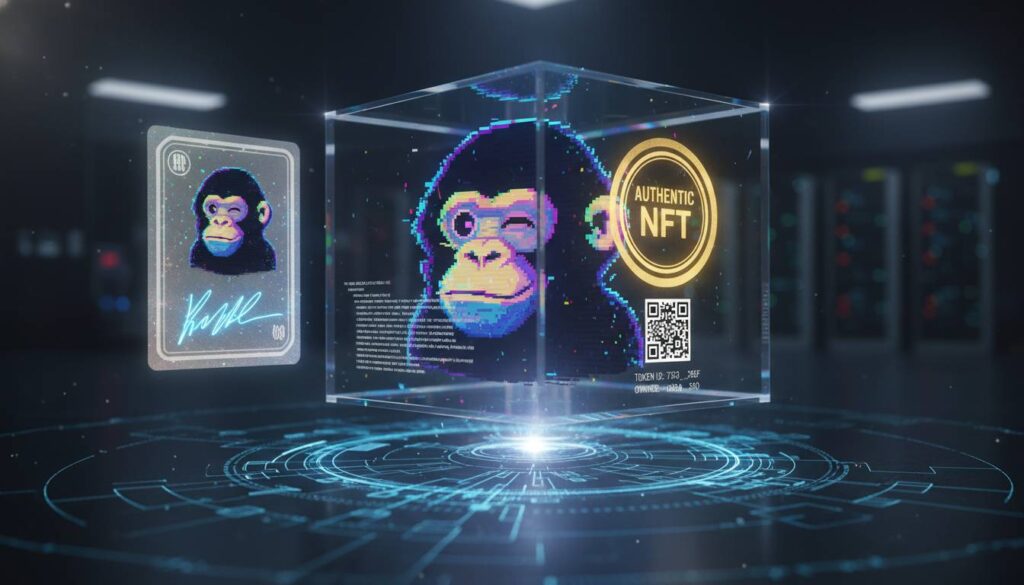
An NFT (Non-Fungible Token) is a unique digital certificate stored on a blockchain that proves ownership of a specific digital item—whether that’s artwork, music, a video clip, a tweet, or even a virtual piece of land. Unlike cryptocurrencies such as Bitcoin or Ethereum, where every unit is identical and interchangeable, each NFT possesses distinct information that makes it one-of-a-kind and impossible to replicate. This digital ownership record cannot be forged, transferred without the owner’s permission, or altered once created, establishing verifiable scarcity and authenticity in the digital realm.
Key Insights
– NFTs utilize blockchain technology to create permanent, transparent records of ownership and transaction history
– The concept originated with “Colored Coins” on Bitcoin in 2012-2014, though CryptoKitties (2017) brought mainstream attention
– The global NFT market reached approximately $4.6 billion in trading volume by late 2021, though activity has fluctuated significantly since
– Unlike cryptocurrencies, NFTs represent unique assets rather than interchangeable units of currency
Understanding the Core Concept: What Makes Something “Non-Fungible”
To grasp what an NFT truly means, it helps to first understand the term “fungible” and why it matters in both digital and physical contexts.
The terms are FCFS and GTD Whitelist, so I did some research🤷♂️. If you’re curious about what these mean and how they affect NFT allocation, I’ve got you covered. 🧵👇(1/6) https://t.co/dIUuIaBr7U
— Ascension🔺 (@0x_ascension) January 29, 2025
Fungible items are goods or assets where every individual unit is essentially identical and can be exchanged for another of the same type without any difference in value or meaning. Consider a $20 bill: it doesn’t matter which specific $20 bill you have—any genuine $20 bill can be exchanged for any other $20 bill because they’re functionally identical. The same principle applies to cryptocurrencies: one Bitcoin equals another Bitcoin; one Ethereum equals another Ethereum.
Non-fungible items, by contrast, possess unique characteristics that distinguish them from every other item of the same type. Think of a original painting versus a printed poster of that same painting, or a signed first-edition book versus a mass-market paperback. The original carries distinct value that cannot be replicated, regardless of how similar the copies appear.
NFTs apply this same logic to digital assets. When you “mint” (create) an NFT, you’re generating a unique digital certificate on a blockchain that identifies a specific file as the original—the digital equivalent of owning an original artwork rather than a reproduction. This distinction solves a fundamental problem that has plagued digital content creators for decades: how to prove and sell authenticity in a world where anything digital can be endlessly copied with a single click.
How NFT Technology Actually Works
The technology underlying NFTs can seem intimidating, but the core mechanics are surprisingly straightforward once broken down into components.
📘 Web6 Explained — Part 4
What is an NFT?
NFT means Non-Fungible Token.
Let’s break that down:🔹 Non-fungible = unique, not interchangeable.
(Unlike a €10 bill, which is the same as any other.)
🔹 Token = a digital asset recorded on a blockchain.So, an NFT is a digital… pic.twitter.com/AuzIc3GIXJ
— Galileo (@galileoprotocol) July 23, 2025
The Blockchain Foundation
NFTs exist on blockchains—decentralized, distributed digital ledgers that record transactions across many computers simultaneously. This decentralization means no single company or authority controls the records; instead, thousands of computers (called “nodes”) maintain identical copies of the transaction history, making the system incredibly difficult to hack or manipulate.
Most NFTs today exist on the Ethereum blockchain, which was the first major platform to implement the ERC-721 standard (the technical protocol that defines how NFTs work). Other blockchains, including Solana, Polygon, Flow, and Tezos, have since developed their own NFT standards, each with different features, costs, and environmental considerations.
Smart Contracts and Metadata
At the heart of every NFT lies a smart contract—a self-executing program stored on the blockchain that automatically enforces specific rules. This smart contract contains the essential information that makes an NFT function:
Imagine spending $635,000 in 2021 at nft which now worths $155
byu/Yournewbestfriend_01 inWellthatsucks
The contract specifies the token ID, a unique identifier that distinguishes this specific NFT from every other token on that blockchain. It also stores or references the metadata—information describing the digital asset itself, including the file name, description, image or media URL, and any additional attributes. The contract maintains the ownership record, permanently tracking which wallet address currently holds the NFT and maintaining a complete history of every previous owner and transaction. Finally, it enables transfer mechanisms, allowing the owner to send the NFT to another wallet address, with the transaction automatically recording on the blockchain.
It’s crucial to understand what NFTs actually represent: in most cases, the NFT itself is not the digital file (which would be impossibly expensive to store entirely on a blockchain). Instead, the NFT contains a link or reference to where that file lives—often on a decentralized storage system like IPFS (InterPlanetary File System) or a traditional web server. This distinction matters because purchasing an NFT typically grants you ownership of the token and its associated rights, but not necessarily exclusive access to view or use the underlying digital content, which may still be freely available online.
Why NFTs Matter: The Benefits and Value Proposition
The NFT phenomenon generated massive buzz, skepticism, and confusion in equal measure. Understanding the actual benefits helps separate meaningful applications from mere speculation.
Provenance and Authenticity
Perhaps the most significant value NFTs provide is establishing verifiable provenance—a transparent, unbroken chain of ownership history. For creators, this means definitive proof of their work’s origin and ownership trajectory. For collectors, it means confidence that what they’re purchasing is genuinely the original item. This application extends far beyond digital art to include luxury goods, tickets, certificates, and any domain where counterfeiting represents a concern.
Creator Empowerment
NFTs introduce new economic models for creators by enabling direct-to-audience sales without intermediaries like galleries, record labels, or publishing houses. Artists can retain ownership of their work and receive ongoing royalties (typically 5-10% of secondary sales) automatically programmed into the smart contract—ensuring they benefit every time their work changes hands in the future. This represents a fundamental shift in how creative professionals monetize their labor.
Programmability and Interoperability
Unlike traditional ownership documents, NFTs are programmable. Developers can embed specific behaviors, unlockable content, or interactive features directly into the token. Additionally, because most NFTs follow standardized formats, they can potentially move across different applications and platforms within the same blockchain ecosystem, creating new possibilities for digital identity and asset portability.
Digital Collectibility
NFTs finally solve the problem of digital collectibles. Before NFTs, anything digital could be copied infinitely with perfect fidelity—making “original” digital items essentially meaningless. NFTs create artificial scarcity in the digital realm, enabling the same psychological satisfaction of collecting rare items that has driven philately, numismatics, and trading cards throughout history.
Common Use Cases: Where NFTs Are Being Applied
While media coverage often focuses on high-profile art sales, NFT applications span numerous industries and purposes.
Digital Art and Collectibles remain the largest category, with platforms like OpenSea, Foundation, and Rarible enabling artists to mint, sell, and trade digital creations. Notable sales include Beeple’s “Everydays: The First 5000 Days” at Christie’s for $69.3 million in March 2021, demonstrating NFTs’ potential to elevate digital art to traditional auction-house prestige.
Gaming represents another substantial application, with NFTs enabling true ownership of in-game items, characters, and land. Games like Axie Infinity, Decentraland, and The Sandbox allow players to earn, buy, and sell assets with real-world value, creating “play-to-earn” economies that have provided income sources in regions with limited traditional employment opportunities.
Music and Entertainment artists have explored NFTs as new revenue and fan-engagement mechanisms, selling exclusive tracks, concert tickets, backstage access, and unique experiences directly to fans.
Domain Names represent a practical application, with blockchain-based domain names (like .eth or .crypto) functioning as NFT-enabled digital real estate that users own rather than rent indefinitely.
Real-World Asset Tokenization is emerging as perhaps the most transformative long-term application, with proposals to represent physical assets—real estate, luxury goods, vehicles—as NFTs, enabling fractional ownership, faster transfers, and increased liquidity for traditionally illiquid assets.
Common Misconceptions and Mistakes to Avoid
The NFT space has generated substantial confusion. Understanding common misunderstandings helps navigate this emerging technology more effectively.
| Misconception | Reality |
|---|---|
| “NFTs are only for expensive art” | NFTs range from free to millions; they can represent any digital or physical asset |
| “I can only sell on one platform” | While most NFTs are bound to specific blockchains, multiple marketplaces exist within each ecosystem |
| “Buying an NFT gives me copyright ownership” | Ownership of the token typically differs from intellectual property rights; always verify what rights transfer |
| “NFTs are bad for the environment” | Environmental impact varies significantly by blockchain; Ethereum’s 2022 “Merge” reduced its energy consumption by approximately 99.95% |
One frequent mistake involves conflating ownership with access. Purchasing an NFT generally grants you the token and associated ownership rights, but the underlying digital content often remains publicly viewable. The NFT proves you own the original; it doesn’t necessarily restrict others from viewing or even sharing copies. Understanding this distinction prevents unrealistic expectations about what NFT ownership provides.
Another common error involves insufficient due diligence before purchasing. The NFT marketplace has experienced scams, fraudulent projects, and “rug pulls” where creators abandon projects after collecting payments. Researching the project team, community engagement, and long-term viability before investing significantly reduces risk exposure.
Getting Started: How to Buy and Create NFTs
For those interested in entering the NFT space, understanding the basic steps helps demystify the process.
To purchase an NFT, you first need a cryptocurrency wallet (such as MetaMask, Coinbase Wallet, or Rainbow) that functions as your digital keychain for blockchain interactions. You’ll need to acquire the blockchain’s native cryptocurrency (ETH for Ethereum, SOL for Solana) to cover both the purchase price and “gas fees” (transaction costs for network operations). Once funded, you can connect your wallet to an NFT marketplace like OpenSea, Foundation, or Nifty Gateway to browse and buy available tokens.
To create (mint) an NFT, you upload your digital file to a minting platform, set your desired parameters (price, royalties, edition size), and confirm the transaction, which creates the NFT on the blockchain. Most platforms allow this process without coding knowledge, though understanding gas fee timing can significantly reduce costs during high-traffic periods.
Security fundamentals warrant serious attention: never share your wallet’s seed phrase (the 12-24 word recovery phrase), double-check transaction details before confirming, and consider hardware wallets for significant holdings.
The Future of NFT Technology
The NFT landscape continues evolving rapidly, with several trends shaping the sector’s trajectory.
Fractional ownership is enabling multiple people to co-own expensive NFTs, democratizing access to high-value digital assets. Dynamic NFTs that change based on external data or events open possibilities for gaming, real-world data integration, and interactive experiences. Cross-chain compatibility improvements are gradually allowing NFTs to move more easily between different blockchain ecosystems. Enterprise adoption is increasing, with major brands from Nike to Starbucks launching NFT-based initiatives, suggesting long-term viability beyond speculative trading.
The technology remains young, and the space will undoubtedly experience additional cycles of hype, correction, and maturation. What seems clear is that the fundamental capability—creating verifiable, programmable ownership records for unique digital items—addresses genuine needs that extend well beyond current applications.
Frequently Asked Questions
What exactly do I own when I buy an NFT?
When you purchase an NFT, you own the unique digital token recorded on the blockchain, which includes proof of ownership, the transaction history, and specific rights as defined by the creator. This does not necessarily include copyright or intellectual property rights unless explicitly stated by the seller. The underlying digital file (image, video, audio) often remains publicly accessible regardless of NFT ownership.
Can anyone create an NFT?
Yes, virtually anyone with access to a cryptocurrency wallet and the necessary funds for transaction fees can create (mint) an NFT. Several platforms like OpenSea, Rarible, and Mintible allow users to upload files and create NFTs without coding knowledge. The process typically costs only gas fees, though some platforms charge additional service fees.
Are NFTs only digital images?
No. While digital art and collectibles represent the most visible category, NFTs can represent ownership of music, videos, domain names, virtual land in gaming worlds, tickets to events, physical goods, and potentially real estate. Any unique item that can be digitally represented can theoretically be tokenized as an NFT.
Why do some NFTs sell for millions while others are worthless?
NFT values depend heavily on the creator’s reputation, cultural significance, scarcity, utility, and collector demand. High-profile artists or celebrities can command premium prices based on existing audiences and track records. Many NFTs fail to retain any value because they lack genuine scarcity, utility, or ongoing community support—highlighting the speculative nature of the market and importance of thorough research before purchasing.
Are NFTs bad for the environment?
Environmental concerns vary significantly by blockchain. Ethereum, the most popular NFT platform, reduced its energy consumption by approximately 99.95% when it transitioned to proof-of-stake consensus in September 2022. Other blockchains like Solana and Tezos also consume substantially less energy than early Ethereum. Environmental considerations should factor into blockchain selection when creating or purchasing NFTs.
How do I know if an NFT is legitimate?
Verifying NFT legitimacy involves researching the project’s team (often anonymous, but communities can provide reputation context), checking the smart contract address and blockchain explorer records, examining ownership history, and assessing community engagement and longevity. Established marketplaces provide some verification, but buyers bear responsibility for due diligence. Be cautious of offers that seem too good, pressure tactics, and unverified links.
The NFT meaning ultimately boils down to one transformative capability: establishing verifiable, programmable ownership of unique digital items. Whether this technology fulfills its transformative potential or ultimately settles into specific niche applications, it has already demonstrated that digital scarcity and ownership represent genuine desires in our increasingly digital world. Understanding the fundamentals—what NFTs are, how they work, and what they actually provide—equips you to evaluate this technology’s role in your own interests, whether as a creator, collector, investor, or curious observer of technological evolution.