
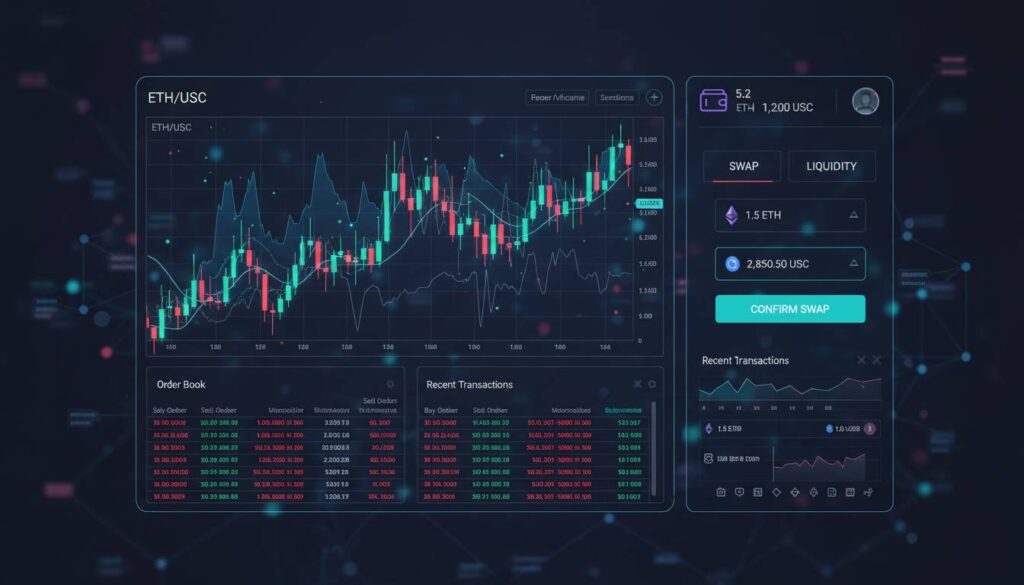
Decentralized Finance (DeFi) represents a fundamental transformation of traditional financial systems through blockchain technology. At its core, DeFi refers to financial applications built on decentralized networks—primarily Ethereum—that operate without intermediaries like banks, brokers, or insurance companies. These protocols use smart contracts to automate financial services, enabling anyone with an internet connection to lend, borrow, trade, and earn interest on digital assets. The total value locked in DeFi protocols has grown from approximately $1 billion in 2020 to over $50 billion at various points, demonstrating the rapid adoption of these permissionless financial tools. This comprehensive guide explores how DeFi works, its key components, major use cases, and the risks and opportunities that define this evolving landscape.
Understanding the Foundation of Decentralized Finance
DeFi emerged from the broader cryptocurrency ecosystem as developers recognized that blockchain technology could do more than simply transfer value. The foundational idea is elegantly simple: replace trust in centralized institutions with trust in code. When you use a traditional bank, you trust that institution to hold your money, process your transactions fairly, and provide accurate account balances. DeFi removes this requirement for trust by making all transaction logic publicly visible on the blockchain and executable automatically through smart contracts.
1/ What is DeFi?
DeFi = Decentralized Finance. Unlike the traditional financial system, it uses smart contracts on blockchains to provide financial services (loans, swaps, yield farming, etc.) without middlemen.
Sounds amazing? It is! But, it isn't without risks.— Kraken (@krakenfx) March 19, 2025
Smart contracts are self-executing programs stored on the blockchain that automatically enforce terms when predetermined conditions are met. For example, a lending smart contract might automatically liquidate collateral if a borrower’s position falls below the required threshold—no human intervention required. This programmability means financial agreements can execute with mathematical certainty, reducing counterparty risk and eliminating the need for trusted intermediaries.
The DeFi ecosystem operates on several blockchain networks, with Ethereum serving as the dominant platform due to its established developer community and robust smart contract capabilities. Other blockchains, including Solana, Avalanche, Binance Smart Chain, and Polygon, have also developed significant DeFi ecosystems. These networks process transactions through various consensus mechanisms, with Ethereum currently operating on a proof-of-stake system following “The Merge” upgrade in September 2022.
Key Components of the DeFi Infrastructure
Understanding DeFi requires familiarity with its fundamental building blocks. Decentralized applications, commonly called dApps, form the user-facing layer of the ecosystem. These applications connect directly to the blockchain, allowing users to interact with financial protocols through their cryptocurrency wallets. MetaMask, Rainbow, and Coinbase Wallet represent the most popular wallet solutions that enable this connectivity.
Blira is a decentralized finance #DeFi , it was created for commercial use in sostitution of classical #Finance, Blira is the complete ecosystem it is based on #Bitcoin (Gold standard) and Blira Coin💷(Currency) anchored to the price of the #USD, #EUR ,#GBP, #CNY pic.twitter.com/7E9n9bKEVz
— Blira®💷 (DeFi) (@Blirapay) July 29, 2020
Decentralized exchanges (DEXs) constitute one of the most critical infrastructure components. Unlike centralized exchanges that match buyers and sellers through order books managed by the exchange operator, DEXs use automated market makers (AMMs). These systems use liquidity pools—reserves of trading pairs funded by users who provide liquidity—to enable instant trades at prices determined by mathematical formulas. Uniswap, Sushiswap, and Curve Finance represent the most widely used DEXs by trading volume.
Liquidity providers (LPs) are users who deposit assets into these pools to facilitate trading. In return, they receive liquidity provider tokens that represent their share of the pool’s fees and incentives. This mechanism creates a self-sustaining ecosystem where users both consume and provide financial infrastructure—a fundamental departure from traditional finance where institutions control market-making functions.
Major DeFi Use Cases and Applications
The lending and borrowing sector represents DeFi’s most established use case. Platforms like Aave, Compound, and MakerDAO allow users to supply cryptocurrencies as collateral and borrow other assets against them. Interest rates on these platforms adjust algorithmically based on supply and demand, typically offering higher yields than traditional savings accounts while providing borrowers with faster access to capital without credit checks. As of early 2024, these protocols collectively hold billions in total value locked, serving millions of unique addresses.
Has anyone seen DeFi mechanics applied to knowledge platforms rather than financial assets?
byu/coobook indefi
Stablecoins form another essential DeFi category. These cryptocurrencies maintain a fixed value—typically $1—through various mechanisms. Dai achieves stability through over-collateralization with other cryptocurrencies, while USDC and USDT maintain reserves held by centralized issuers. These tokens enable DeFi users to hold dollar-denominated value within the crypto ecosystem, facilitating trading, lending, and yield generation without converting back to traditional currency.
Yield farming, also known as liquidity mining, emerged as a prominent DeFi activity where users move assets between different protocols to maximize returns. Advanced strategies might involve depositing borrowed funds to generate additional yield, a practice known as leverage farming. While potentially lucrative, these strategies carry significant complexity and risk, as demonstrated by various protocol collapses that have resulted in substantial user losses.
The Risks and Challenges Facing DeFi
Despite its revolutionary potential, DeFi carries substantial risks that users must understand. Smart contract vulnerabilities represent perhaps the most feared risk category. Since smart contracts manage billions of dollars in user funds, any coding error can lead to catastrophic losses. The DAO hack in 2016 resulted in approximately $60 million in ether being stolen due to a recursive call vulnerability, and numerous subsequent exploits have demonstrated that even audited contracts can contain fatal flaws.
https://www.youtube.com/watch?v=UyszoJGzKVk
Impermanent loss affects liquidity providers on AMMs when the price relationship between deposited tokens diverges from their original ratio. While providing liquidity generates fee income, price volatility can ultimately leave LPs with less value than simply holding their tokens. This phenomenon catches many inexperienced providers off guard and represents a hidden cost of participation in liquidity provision.
Regulatory uncertainty casts a long shadow over the entire DeFi ecosystem. Securities regulations, banking laws, and money transmission requirements remain largely undefined for decentralized protocols. Some projects have faced enforcement actions, while others have structured themselves to minimize regulatory exposure. The anonymous nature of many DeFi developers complicates this further, as enforcement becomes difficult when no identifiable entity can be held accountable.
The Future Evolution of Decentralized Finance
The DeFi ecosystem continues evolving rapidly, with several promising developments on the horizon. Layer 2 scaling solutions, including optimistic rollups and zero-knowledge rollups, aim to reduce transaction costs and increase throughput on Ethereum. These technologies bundle multiple transactions into single submissions to the base blockchain, potentially making DeFi accessible to users deterred by high gas fees during network congestion.
Cross-chain interoperability represents another critical development direction. As multiple blockchain networks develop robust DeFi ecosystems, the ability to move assets seamlessly between them becomes increasingly valuable. Bridges connecting different blockchains have emerged, though several high-profile hacks have highlighted the security challenges involved in cross-chain communication.
Institutional adoption appears increasingly likely as major financial institutions explore DeFi infrastructure. While widespread corporate participation remains limited by regulatory ambiguity, several banks and investment firms have conducted experiments with blockchain-based settlement and lending. The integration of traditional finance (TradFi) elements with DeFi—sometimes called “CeDeFi” or centralized-decentralized hybrid finance—may provide a bridge toward broader adoption.
Frequently Asked Questions
What is the difference between DeFi and traditional finance?
Traditional finance relies on centralized intermediaries like banks, brokerages, and clearinghouses to facilitate transactions, manage records, and enforce rules. DeFi replaces these intermediaries with smart contracts that automatically execute transactions when conditions are met. This shift removes the need for trust in institutions, enables 24/7 global access, and typically reduces transaction costs by eliminating middlemen. However, DeFi requires technical knowledge to use safely and lacks the consumer protections that traditional financial institutions provide.
How do I get started with DeFi?
To begin using DeFi, you first need a cryptocurrency wallet like MetaMask. After installing a wallet browser extension or mobile app, you can purchase cryptocurrency on a centralized exchange and transfer it to your wallet. From there, you can connect to DeFi protocols through the wallet interface. Start with small amounts to learn the mechanics, and never invest more than you can afford to lose. Understanding how to verify contract addresses and recognize phishing attempts is essential for security.
Is DeFi safe to use?
DeFi carries significant risks including smart contract vulnerabilities, temporary loss from liquidity provision, and potential loss of funds through hacks or fraud. No central authority can reverse transactions or reimburse losses. Users should conduct thorough research, prefer protocols with established track records and professional audits, and never share their wallet seed phrase. Diversifying across multiple protocols and maintaining only necessary funds in DeFi can help manage exposure to these risks.
What are gas fees in DeFi?
Gas fees are transaction costs paid to blockchain networks for processing operations. On Ethereum, these fees fluctuate based on network demand and are denominated in gwei (a fraction of ether). During periods of high activity, gas fees can become substantial, making small transactions economically impractical. Layer 2 solutions and alternative blockchains offer lower fee structures, though they may present different trade-offs regarding security and ecosystem maturity.
Can I lose money in DeFi?
Yes, users can and do lose money in DeFi through various mechanisms. Smart contract exploits have resulted in billions of dollars in losses over the years. Liquidity providers may experience impermanent loss when token prices diverge. Scams and phishing attacks continue targeting DeFi users. Additionally, the volatile nature of cryptocurrency assets means that collateral positions can be liquidated during price downturns, potentially resulting in losses exceeding the original borrowed amount.
What is total value locked (TVL) in DeFi?
Total Value Locked represents the aggregate amount of cryptocurrency deposited into DeFi protocols, serving as a measure of ecosystem size and user trust. TVL fluctuates as users deposit or withdraw funds and as cryptocurrency prices change. While TVL provides useful insight into DeFi adoption trends, it doesn’t necessarily indicate protocol health or safety, as TVL can be artificially inflated through incentive programs or borrowed capital.